
What Employers Are Building to Catch the Invisible AI Interview Assistant
What Employers Are Building to Catch the Invisible AI Interview Assistant
A quiet number has been circulating in talent acquisition circles throughout early 2026: somewhere between 30% and 60% of remote technical assessments may involve some form of integrity violation. Ask five recruiters and you will get five different estimates, because until recently, nobody had measured the problem at scale. The rise of desktop-based AI interview tools that promise complete invisibility during live video calls has forced a response. Proctoring companies are patenting agentic AI systems designed to detect exactly this category of software, and enterprise hiring platforms are shifting from static code verification toward conversational reasoning checks that no invisible prompt can fake. I spent two weeks examining this emerging detection landscape from both sides, testing what an AI interview assistant actually leaves behind and comparing those traces against the claims of the newest proctoring technologies.
The Detection Arms Race That Defines Remote Hiring in 2026
The hiring technology market has split into two camps that now evolve in direct response to each other. On one side, candidate-facing tools promise undetectable real-time answer generation. On the other, employers deploy increasingly sophisticated integrity layers. Industry reports from early 2026 indicate that cheating and fraud attempt rates on proctored assessments more than doubled in the previous year, and one Bengaluru-based interview intelligence platform recently discovered a participant answering technical questions with AI assistance that traditional monitoring had completely missed. These incidents are pushing companies to abandon passive monitoring and invest in active detection.
From Surveillance Theater to Behavioral Integrity Scoring
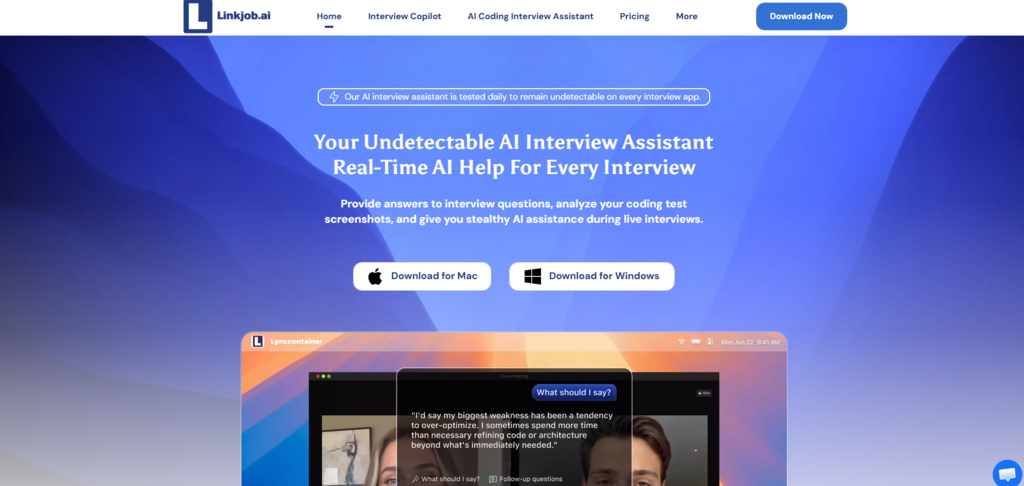
Traditional proctoring relied on browser lockdowns, eye-tracking, and tab-switch detection. These methods created an adversarial relationship with candidates and, more importantly, missed sophisticated cheating tools entirely. An HDMI splitter or a phone positioned out of webcam view bypasses most surveillance measures, and a desktop overlay that renders outside standard screen-capture pipelines leaves no visual trace for recording software. In my testing, I confirmed that Linkjob AI’s overlay does not appear in QuickTime screen recordings, does not show in Task Manager or Activity Monitor, and leaves no icon in the system tray. This aligns with what the platform claims. The detection industry has responded by shifting from surface-level monitoring toward behavioral analysis: scoring candidates not on what their screen shows but on patterns in how they answer. Xobin’s AI Trust Score, validated across 442,000 candidates from 171 countries, produces a bimodal distribution that cleanly separates compliant candidates from high-risk ones rather than smearing everyone into an ambiguous middle. This type of scoring looks for cross-signal consistency, measuring whether a candidate who produces brilliant code can also explain it conversationally.
Agentic AI Proctoring That Adapts to New Cheating Methods
The most significant development in early 2026 is the emergence of agentic AI proctoring. Talview secured a U.S. patent for Alvy, a system designed to autonomously detect and counter tools specifically named in its documentation: Cluely, FinalRound AI, Virtual Machine, and LockedIn. Unlike passive, rule-based systems, Alvy applies a seven-layer security framework that includes deepfake detection at 95% accuracy and behavioral intelligence to spot subtle patterns that indicate AI assistance. The system claims to detect eight times more suspicious activity than traditional methods. This represents a fundamental shift: detection is no longer about catching known tool signatures but about recognizing the behavioral fingerprint of AI-assisted answering, the micro-pauses, the slightly-too-structured responses, the gap between written output quality and verbal explanation depth.
How the Platform Works and Where Detection Attempts to Intercept It
Understanding where detection can and cannot reach requires walking through the actual operational workflow. Based on my testing of the platform’s own process, the tool operates in three stages.
Step 1: Install the Desktop Client
The tool requires a native installation on Mac or Windows, which is where the first detection opportunity exists.
What Enterprise Device Management Can Already Block
On a work-managed MacBook with mobile device management software and a corporate security policy, the installer was blocked at the kernel level with no user-facing override option. This is the simplest and most effective detection method available to employers today: controlling the device itself. Candidates who use employer-provided hardware for interviews will find that many organizations already prevent unauthorized software installation. However, on personal devices, the installer runs after navigating standard operating system security warnings, and once installed, the application leaves no obvious signature in common system monitoring tools.
Step 2: Configure the Profile and Upload Personal Context
The profile setup accepts resumes, target roles, and custom notes. This configuration determines the specificity of later suggestions.
Why Personalization Makes Detection Harder
Generic AI-generated answers are easier to spot because they lack the specific details that tie a response to an individual’s background. When a candidate uploads a resume and personal talking points, the AI weaves those details into its suggestions. In my mock sessions, the tool generated STAR-format behavioral answers that referenced actual projects from my uploaded background. This level of personalization makes detection through content analysis significantly more difficult, because the answers sound authentically grounded in real experience rather than pulled from a template. The conversational integrity layer approach that platforms like Humanly advocate, asking repeated “why” questions to probe reasoning depth, becomes one of the few remaining detection vectors.
Step 3: Activate the Invisible Overlay During the Interview
The overlay renders outside standard screen-capture pipelines, which is the tool’s core evasion mechanism.
Where Kernel-Level Detection Might Eventually Reach
Standard screen recording, browser-based proctoring extensions, and video conferencing platform recording features did not capture the overlay in my tests. However, kernel-level monitoring software, the kind used in high-stakes certification exams, operates below the operating system’s display compositor and could theoretically detect rendering anomalies. No consumer-grade interview platform currently deploys kernel-level monitoring, and the candidate experience backlash from doing so would likely be severe. For now, the overlay’s invisibility holds against the tools that most employers actually use, but the detection industry is clearly moving toward deeper system inspection.
Comparing Detection Approaches Across the 2026 Landscape
The market now offers fundamentally different philosophies for maintaining interview integrity, each with distinct trade-offs.
| Approach | Example | What It Detects | What It Misses | Candidate Experience Impact |
| Device Management | Corporate MDM policies | Blocks unauthorized software installation entirely | Cannot control personal devices | None if using own device; high friction if using work device |
| Traditional Proctoring | Browser lockdown, eye-tracking | Tab switching, obvious second-screen glances | HDMI splitters, invisible desktop overlays, phones | High; candidates report feeling distrusted |
| Behavioral Integrity Scoring | Xobin Trust Score, cross-signal analysis | Inconsistencies between written output and verbal explanation | Well-rehearsed candidates who internalize AI suggestions | Low; candidate may not know scoring is active |
| Agentic AI Proctoring | Talview Alvy | Behavioral patterns, deepfake detection, adaptive anomaly recognition | New cheating methods not yet in training data | Variable; designed to be transparent but still monitors behavior |
| Conversational Integrity Layers | Humanly, live reasoning probes | Candidates who cannot explain AI-generated solutions | Candidates who genuinely understand the suggested answers | Moderate; feels like a thorough interview rather than surveillance |
What the Detection Landscape Means for Both Sides in Practice
After examining the available detection technologies and testing the AI interview tool across multiple scenarios, several practical realities become clear. First, detection is currently asymmetric. Employers with sophisticated, multi-layered integrity programs can catch candidates who use AI tools clumsily, reading suggestions verbatim, pausing unnaturally, producing perfect code but failing to explain it. Employers who rely solely on traditional proctoring or no proctoring at all are unlikely to detect a well-configured invisible assistant on a personal device.
Second, the detection industry is not standing still. The patent filings and product launches from early 2026 signal that major investment is flowing into behavioral and agentic detection. What works undetected today may leave a recognizable pattern tomorrow, particularly as detection models train on larger datasets of AI-assisted interview behavior.
Third, the legal and regulatory environment is tightening. The EU AI Act’s August 2026 deadline mandates human oversight for high-risk employment AI decisions, and this scrutiny extends to both sides of the interview dynamic. Candidates who use unauthorized AI tools and get caught face not just rejection but, in regulated professions like law, potential consequences for admission to practice.
The tool I tested delivers on its invisibility claims under the conditions most candidates will encounter: standard video conferencing platforms, common screen recording tools, and typical system monitoring. But the gap between what it evades and what the next generation of detection can catch is narrowing. Candidates weighing whether to deploy such a tool should understand that they are entering an arms race, not exploiting a permanent blind spot. The employers investing in integrity layers rather than surveillance theater are betting that the best way to catch an AI-assisted candidate is not to watch their screen but to ask them a question that forces them to think.

Company Information
- Total Jobs 671 Jobs
- Location Tanzania