
How to Choose the Right Microscope for School, Lab, Clinic or Home
How to Choose the Right Microscope for School, Lab, Clinic or Home
A good microscope opens up a world that is invisible to the naked eye, from the cells in an onion skin to the fine structure of an insect’s wing. For schools, it is one of the most important pieces of science equipment. For clinics and laboratories, it is a daily working tool. And for curious hobbyists, it can become a lifelong interest.
The difficulty is that microscopes vary enormously in design, quality and purpose. Two instruments that look similar in a photo can perform very differently in use. This guide explains the main types, the specifications that genuinely matter, and how to buy and care for a microscope so it gives years of reliable service.
How to Choose the Right Microscope
Start with how it will be used
Before comparing models, be clear about who will use the microscope and what they will look at. A secondary school biology lab needs sturdy instruments that can survive many pairs of hands. A university student may want something portable for revision. A clinic or diagnostic lab needs consistent, high-resolution optics for examining prepared samples. A hobbyist looking at coins, plants or insects may be better served by a completely different type of instrument, and a parent buying for a curious child has different priorities again.
Once you know the job, it becomes much easier to narrow the options. It is also worth comparing current offers before you commit, because specifications and condition vary widely between sellers. Looking through several listings for a microscope helps you see which objectives, lighting and accessories are included, and whether a used instrument has been well looked after.
The main types of microscope
Compound microscopes
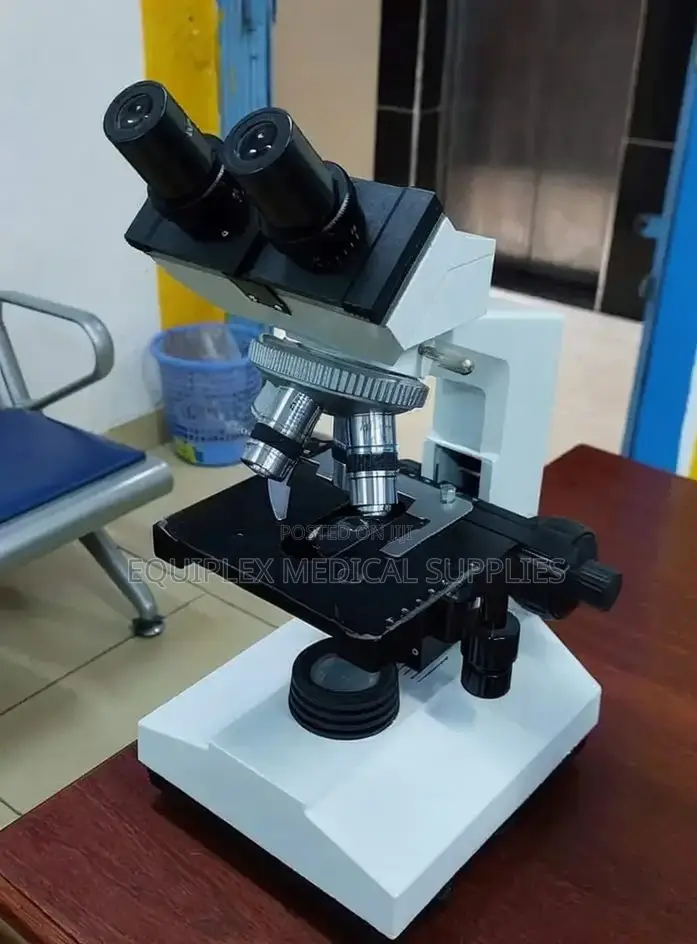
The compound microscope is the classic laboratory instrument. Light passes up through a thin, often stained specimen mounted on a glass slide, and two sets of lenses, the objective and the eyepiece, magnify the image. Compound microscopes are used for cells, tissues, bacteria, blood smears and similar samples. They are the standard choice for biology teaching, medical labs and clinics.
Stereo (dissecting) microscopes
A stereo microscope gives a three-dimensional view of larger, solid objects at lower magnification, typically in the range of around 10x to 40x, though some models go further. It has a long working distance, so there is room to handle the specimen under the lens. Stereo microscopes are ideal for dissection, looking at insects, plants, seeds, rocks, circuit boards, jewellery and watch parts.
Digital and USB microscopes
Digital microscopes use a camera to display the image on a screen, computer or phone. Simple USB microscopes are inexpensive, portable and useful for showing an image to a group, inspecting electronics or taking quick photos. However, many budget models advertise very high magnification figures that do not reflect real optical quality. For serious biological work, a proper compound microscope, optionally fitted with a camera, usually gives far better results.
Monocular, binocular or trinocular?
- Monocular microscopes have a single eyepiece. They are simpler, lighter and often preferred for younger pupils and basic school use.
- Binocular heads have two eyepieces. They are more comfortable for longer sessions and reduce eye strain, which makes them the usual choice in clinics, labs and universities.
- Trinocular heads add a third port for a camera. This is useful for teaching, documentation and sharing images on a screen while still viewing through the eyepieces.
Magnification versus resolution
Many buyers focus on the highest magnification figure, but this can be misleading. Total magnification is simply the objective power multiplied by the eyepiece power. A 40x objective with a 10x eyepiece gives 400x.
What really matters is resolution: the ability to show two nearby points as separate. Resolution depends mainly on the quality and numerical aperture of the objective lens, not on how large the image is made. For standard light microscopes, the useful maximum is generally around 1000x, achieved with a 100x oil immersion objective and a 10x eyepiece.
Beyond that point, the image gets bigger but no new detail appears. This is known as empty magnification. Be cautious of cheap instruments claiming 2000x, 5000x or more; they may simply be enlarging a blurry image. A sharp 400x view is far more useful than a fuzzy 1600x one.
Objectives explained
Most compound microscopes have a rotating nosepiece holding three or four objectives. A common set is:
- 4x for scanning and locating the area of interest
- 10x for general viewing of tissues and larger cells
- 40x for more detail, such as individual cells
- 100x oil immersion for the highest detail, such as bacteria and blood cells, used with a drop of immersion oil between the lens and the cover slip
Look for achromatic objectives as a sensible minimum; they are corrected to reduce colour fringing. Higher grades such as plan achromatic objectives keep more of the field of view in focus from centre to edge, which is valued in clinical and research work. Spring-loaded 40x and 100x objectives help protect slides from accidental contact.
Illumination
Good lighting is essential for a clear image. Most modern microscopes use LED illumination, which runs cool, uses little power and lasts a long time. Some models include a rechargeable battery, which is helpful in classrooms without a socket at every bench or where the power supply is unreliable.
Halogen lighting gives a bright, warm light and is still found on many laboratory instruments, but the bulbs run hot and need replacing periodically. Whichever type you choose, check for adjustable brightness. A condenser with an iris diaphragm lets you control contrast and is important for higher magnifications. Stereo microscopes often have both top lighting for solid objects and bottom lighting for transparent specimens.
Stage and focusing
A mechanical stage holds the slide in a clip and moves it smoothly using two control knobs. This makes it much easier to scan a sample at high magnification than pushing the slide by hand, and it is strongly recommended for anything above basic primary-school use.
For focusing, look for separate coarse and fine focus controls. Fine focus is essential at 400x and above. A focus stop or tension adjustment helps prevent the objective being driven into the slide. The movement should feel smooth, without grinding or slipping.
Build quality
A solid metal frame gives stability and durability, which is especially valuable in school labs. Glass optics are preferable to plastic lenses. Instruments with many plastic parts may be fine for young children but usually do not stand up to heavy classroom use.
Useful accessories
- Plain glass slides and cover slips
- Prepared slide sets for teaching
- Immersion oil for the 100x objective
- Lens paper and lens cleaning solution
- A dust cover
- A camera adaptor for trinocular models
Buying tips, including used microscopes
Whether buying new or second-hand, it pays to be thorough:
- Check the specifications in writing. Confirm the objectives, eyepieces, head type, light source and whether a mechanical stage is included.
- Look through it. If possible, view a prepared slide at every objective. The image should be sharp, evenly lit and free of haze, spots or colour fringes.
- Inspect the lenses. Shine a light through the objectives and eyepieces. Web-like threads, cloudy patches or spots may indicate fungus, which is difficult to remove.
- Test the mechanics. Focus knobs, stage controls and the nosepiece should move smoothly without play.
- Ask about history. Find out where it was used and stored, and whether it has been serviced.
- Be sceptical of extreme claims. Very high magnification figures with no mention of objective quality are a warning sign.
Buying for school labs
Schools usually benefit from buying several identical instruments so that teaching is consistent and spare parts are interchangeable. Robust monocular or binocular compound microscopes with LED lighting, a mechanical stage and 4x, 10x and 40x objectives cover most secondary-school practicals. One or two stereo microscopes are a valuable addition for dissection and examining whole specimens.
Care and storage
With proper care, a quality microscope can last for decades:
- Cover it with a dust cover whenever it is not in use.
- Carry it with two hands, one on the arm and one under the base.
- Clean lenses gently using proper lens paper, never tissue, cloth or fingers. Use a small amount of lens cleaning solution for stubborn marks.
- Remove immersion oil from the 100x objective after every use.
- Store it somewhere dry. Humidity encourages fungus to grow on lenses, which is a real risk in warm, humid conditions. A well-ventilated cabinet, ideally with silica gel sachets, helps.
- Lower the stage and set the lowest objective in place before storing.
The bottom line
The right microscope depends on what you need to see. A compound microscope suits cells and prepared slides, a stereo microscope suits solid objects and dissection, and a digital model is handy for sharing images. Focus on optical quality and resolution rather than headline magnification, remember that around 1000x is the practical limit for light microscopes, and look for sensible features such as achromatic objectives, LED lighting, a mechanical stage and fine focus. Inspect used instruments carefully for fungus and worn mechanics, and store every microscope covered and dry.

Company Information
- Total Jobs 671 Jobs
- Location Tanzania