End Line Evaluation Consultancy Opportunity at UMATI
End Line Evaluation Consultancy Opportunity at UMATI
END LINE EVALUATION CONSULTANCY
Project Title: Scaling up Access to Integrated SRH Services in public health facilities through Outreach Approaches in Kigoma – UMKOBA Project Phase III.
Project Period: Three Years (2023-2026)
Funding Agency: Bergstrom Foundation
Implementing Institution: UMATI
INTRODUCTION
Chama cha Uzazi na Malezi Bora Tanzania (UMATI) is an autonomous, non-political national NGO providing Sexual and Reproductive Health and Rights (SRHR) information, education, and services in Tanzania. It has been in operation since 1959 and became a leading national organization providing quality youth-friendly SRH information and services particularly to young people and women. In 1973 UMATI became a member association for International Planned Parenthood Federation (IPPF) where technical and core funds support was provided. By being a member of IPPF, UMATI is internationally connected through experience sharing with other IPPF member associations.
UMATI is envisioning to see a Tanzania where people are free to choose and exercise their Sexual and Reproductive Health and Rights without discrimination in gender, sex, and age. The visioning process of UMATI highlighted the need to integrate “without discrimination” as a recurring theme as well as an organizational value statement. “Freedom of choice” was agreed as a paramount inclusion at the end that UMATI would love to see by doing its core business.
UMATI’s mission is to champion SRHR and provide information and services targeting the young and underserved. In coming up with the Mission Statement, cognizance was put on the strategic position of UMATI as a leading SRHR service provider in Tanzania. This was eventually replaced by “champion” recognizing the need to lead not only by the provision of services but also by enabling other service providers including capacity building to local CSOs partners in the country to champion SRHR through their advocacy initiatives. UMATI strives for structural poverty reduction by improving the health of people in the country regardless of gender and political or religious beliefs, with priorities being given to the poorest communities and hard-to-reach populations.
ABOUT THE PROJECT
The UMKOBA project intended to expand access to integrated SRH services in rural areas of Kigoma covering five district councils of Kasulu TC, Kasulu DC, Uvinza, Kibondo, Uvinza and Kakonko DCs. It provided SRH/FP services in 40 health facilities. 80 CHWs provided referrals to these facilities. The project used the following approaches to reach the desired results; –
- Cluster Model for strengthening health system in service provision;
- Capacity building to healthcare providers;
- Demand creation through sensitization and mobilization meetings;
- Mobile outreach in hard-to-reach communities;
- Health facility-based outreaches;
- Community-based model (CHWs, PEs) for SRH education, community-based distribution services and referral provision;
- Youth Weekend Clinic model for provision of spaces for youth friendly services;
During the project implementation, capacity building for service providers, Community Health Workers (CHWs), and Youth Peer Educators (YPEs) was conducted through various training sessions.
- 22 peer educators were trained on the Sexual and Reproductive Health/Family Planning (SRH/FP) peer education package.
- 40 CHWs received training on the provision of the SRH/FP services.
- 9 service providers from public facilities were trained in permanent methods of family planning.
Family planning services were provided through CHWs, youth weekend clinics, Youth Bonanza, service day campaigns, and mobile outreach in hard-to-reach areas. Demand creation was supported closely by the Local Government Authority, CHWs, and PEs to ensure clients were mobilized for these services.
GEOGRAPHIC COVERAGE
This project is implemented in five District Councils in Kigoma regions including Kasulu DC, Kasulu TC, Kibondo DC, Kakonko DC, and Uvinza DC.
PROJECT GOAL: To contribute towards improved sexual and reproductive health (SRH) outcomes of women, men, adolescents, and youth in Kigoma.
PROJECT OBJECTIVES
- To increase access to integrated SRH services, particularly LAPM to 84,754 Women of reproductive age, 25-49, young people aged 10-24, and 15 Men with the permanent method in the Kigoma Region by 2026.
- To increase access to comprehensive SRHR information to 143,234 women of reproductive age, men, and youth in Kigoma Region by 2026
PROJECT EXPECTED RESULTS
- 21,600 youth reached through increased awareness of integrated SRHR information and services for women of reproductive age, men, and girls in the project target areas through youth weekend clinic
- Providing 171,583 Family planning services and generating a total of 288,905 CYP.
- Providing 103,208 services through CHW referrals and generating a total of 175,930.42 CYP.
- Providing 68,374 services through mobile unit and generating a total of 112,974 CYP.
TERMS OF REFERENCE
UMATI plans to conduct an endline evaluation of the UMKOBA Project Phase III to assess overall performance, outcomes, and impact at the completion of the project period.
The evaluation will be conducted at the end of implementation (2026) among a representative sample of beneficiaries, including women of reproductive age, men, and youth aged 10–24. The findings will inform accountability, learning, and future programming.
OBJECTIVES OF THE EVALUATION
The overall objective of the endline evaluation is to assess the extent to which the project has achieved its intended outcomes and impact over the full implementation period.
End evaluation Specific Objectives:
- Assess Project Effectiveness: Evaluate the extent to which the project has achieved its intended goals and objectives, including promoting SRH/FP and utilization of SRH/FP among women of reproductive age, men and young people (adolescents and Youth), strengthening SRH service provision, and fostering a supportive environment for SRH provision.
- Evaluate Sustainability: Assess the likelihood that the project’s benefits will continue beyond its duration, ensuring ongoing support and improvements in SRH/FP provision for women of reproductive age and young people.
- Identify Best Practices and Lessons Learned: Provide recommendations for future SRH initiatives by identifying successful strategies, areas for improvement, and lessons learned from the project’s implementation, and thus inform future SRH programming.
- Primary Audiences for the End-Term Evaluation Findings
End-term findings will primarily be used:
- By the project team to refine the project implementation approaches and plans to enable the project to achieve its objectives.
- By partners and stakeholders in Tanzania, such as government departments/ministries, local authorities, local Non-Government Organization and communities, to inform the broader understanding of sexual and reproductive health and rights (SRHR), especially modern contraceptive use among women and youth to prevent teenage and unintended pregnancy in the targeted project areas.
- By UMATI to demonstrate accountability for the funding received from the donor (Bergstrom Foundation).
EVALUATION CRITERIA
The end-term evaluation will follow six OECD/CDAC evaluation criteria; –
- Relevance: The extent to whether the project and its objectives are consistent with problems identified and actual needs and align with national policies and Gov’t of Tanzania priorities.
- Coherence: The extent to whether the project is compatible with any other interventions within Kigoma context.
- Effectiveness: The extent to whether the objective and results of the intervention have been achieved via the activities implemented.
- Efficiency: The measure of how economically resources/inputs (funds, expertise, time) are converted into results. This includes operational and financial management.
- Impact: The measure of long-term effects, intended or unintended, positive or negative, higher-level effects (social, economic, environmental) produced by the project, directly or indirectly
- Sustainability: the extent to whether the action will continue once the project phases out or after BF funding ceases. This includes financial, institutional, social, and environmental sustainability.
Key Endline-Term Evaluation Questions
Relevance
- Have the intervention strategies and methodologies been timely and adequately adapted to remain relevant regarding changes in the context within the period of implementation?
- Is the project required?
- Are the objectives appropriate to meet the needs of the targeted population in terms of improvement of access to quality SRH services?
- Does the project meet the SRH needs of women, adolescents and youth?
- How? What has changed?
- To what extent have the project activities reached the target population?
- How well did the project cover the geographical areas where the target population resides?
- Coherence
- Was the project design coherent with policies/objectives of the national/Regional health authorities, the context?
- Is the project coherent with the approach developed by other partners on these topics?
- To what extent has the project successfully coordinated with relevant stakeholders?
- How well did the project activities follow a logical sequence from start to finish?
- Were the project goals, activities, and outcomes consistently aligned throughout the project duration?
- How effective were the different project approaches/strategies complemented to each other to achieve the overall objectives?
- How clear and consistent was the communication between project team members and stakeholders?
- Did the implementation of project activities align with the planned timeline and objectives?
Effectiveness
- Have the specific objective / expected results been achieved?
- To what extent did the project achieve its intended outcomes and impact compared to baseline and national indicators (e.g., CPR, unmet need, method mix, age distribution of users)?
- How effective were the linkages between community volunteers, health facilities, and mobile outreach services
- To what extent has the project changed SRH services seeking behaviors of the target communities?
- Did the project raise SRH awareness among the targeted communities?
- How effective was the mobile unit/Van in delivering SRH services?
- Are targeted groups i.e. women and adolescent/youth reached? How many have been reached, and do they have access to adequate healthcare?
- Have the SRH/FP demand creation activities contributed to an increase in utilization of SRH/FP services at the targeted health facilities?
- Factors that caused obstacles in achieving objectives. How has the project handled these factors? And what strategies were employed?
- Were the adopted health promotion methods appropriate?
Sustainability
- To what extent have key sustainability issues been effectively addressed and what mechanisms in place to ensure sustainability?
- Are the involvement and training of Community health workers, Youth peer educators, and healthcare providers sufficient to prepare them for the handovers?
- To what extent did trained individuals (CHWs, Peer Educators, service providers) apply their skills, and what outcomes resulted?
- Did the program ensure anchoring of community ownership through community participation?
- To what extent are project interventions sustainable, particularly:
- Cluster Model
- Capacity building efforts
- Community volunteer engagement
- Mobile outreach services
- Youth Weekend Clinics
Efficiency
- Were the project activities completed within the allocated budget? If not, what were the reasons for any deviations?
- How well did the project team optimize the use of available resources to achieve the project goals?
- Were the project milestones and deadlines met as planned? If not, what were the main causes of delays?
- Were there any specific strategies or practices that significantly improved the efficiency of the project?
- Was there an efficient management in place to support the project implementation?
- How would you rate the overall efficiency of the project on a scale from 1 to 10?
- What were the main strengths and weaknesses in terms of efficiency throughout the project?
- What lessons were learned regarding efficiency that could be applied to future projects?
- What lessons have been learned, and what best practices can be replicated or scaled up in future programs?
Impact
- What is the overall impact of the project on SRH service uptake and access in the target communities?
- What changes occurred in knowledge, attitudes, and practices among beneficiaries as a result of the project?
Key Documents
Core Program Documents/Tools:
- Semiannual donor Reports (from July 2023): To track program activities, achievements, and challenges.
- Data tracking tool: For tracking program indicators and monitoring progress.
- UMKOBA Proposal (including log frame and budget): To understand project design, goals, and resource allocation.
- UMATI strategic plan: To ensure alignment with broader mission goals.
- Health Facilities Support Framework: To understand the specific approach and interventions implemented.
- Tanzania Health National Policies: To assess project alignment with national health strategies.
- Monitoring Forms: To collect detailed data on service utilization from the Service Provision Register,
- Job Descriptions: To understand roles and responsibilities of staff involved in the project.
- UMKOBA Implementation Plan: To assess planned activities and timelines.
- Mid-term evaluation report: To evaluate the effectiveness of baseline assessments, protocols, and support tools used for specific interventions.
- Any document maybe required by the consultant.
Ethics
- Safeguarding Children and Vulnerable Adult
UMATI is committed to actively safeguarding children, youth and vulnerable adult from harm and ensuring their rights to protection are fully realized. UMATI takes seriously the commitment to promote child safe practices and protect children and vulnerable adult from harm, abuse, neglect, and any form of exploitation as they come into contact with UMATI-supported interventions. In addition, we will take positive action to prevent child abusers from becoming involved with UMATI in any way and take stringent measures against any UMATI Staff and/or Associate who abuses a child or any vulnerable adults. Decisions and actions in response to safeguarding concerns will be guided by the principle of ‘the best interests of the child.’
The end-term evaluation will involve conducting interviews with adolescents exploring sensitive topics, such as sexual activity and gender-based violence. The evaluation must, therefore, ensure appropriate, safe, non-discriminatory participation; stressing all young women’s and young men’s views are collected; a process of free and un-coerced consent and withdrawal; confidentiality and anonymity of participants. Environments and working methods should be adapted to the capacities of adolescents; time and resources should be made available to ensure that adolescent girls and boys are adequately prepared and have the confidence and opportunity to contribute their views.
Consultants are required to provide a statement within their proposal on how they will ensure ethics and protection of adolescents, including the young adolescents aged 10-14 years, in the different stages of the study including ethical clearance, recruitment and training of enumerators, data collection and analysis, visits, and report writing in line with UMATI’s Safeguarding Policy. This must also take into account any risks related to the study and how these will be mitigated. Consideration must be given to:
- Safeguards to protect the confidentiality of those participating in the study.
- Data protection and secure maintenance procedures for personal information.
- Caregivers’ consent concerning data collection from adolescents and collation of data about adolescents.
- Age-appropriate assent processes.
Ethical Approval
The consultant must coordinate with UMATI to obtain and adhere to research ethics approval processes from a relevant authorized body before commencement of data collection. The consultant must clearly articulate a preparation and submission plan, and secure ethical approval from Tanzania National Institute for Medical Research or any other authorized body including associated costs, realistic timeline of acquiring it and any other relevant facts regarding ethical clearance in the technical response to this RFP.
Expected Output and Deliverables
- Inception report:
An inception report will be produced at the start of the mission by the evaluation team after having reviewed the key documents and the initial interviews. Among other things, the inception report defines and formalizes the planned methodology and the evaluation matrix, sets out the necessary data collection instruments (questionnaire, interview guides etc.) and suggests a realistic work plan with a detailed and final calendar. The inception report will be submitted to the Steering Committee for comments and validation during the inception meeting.
Evaluation report:
An interim version of the final evaluation report is provided at the end of the field phase. It will be submitted to the Steering Committee for comments and discussions. UMATI then has 10 days to draw up any comments and observations. The definitive final report must integrate these comments/observations/debates/ discussions. The consultant is required to provide two final reports i.e. 1) summary and 2) detailed. The main body of the evaluation report must run to between 40 and 50 pages (excluding annexes), be submitted in Word, be in line with UMATI guidelines that will be provided (respect of primary and secondary colors, type font, 12-point font and single spacing), and must include the following:
- Executive summary (maximum of 5 pages)
- Introduction
- List of acronyms
- Context (description of the project)
- Evaluation objectives and chosen criteria.
- Methodology and limitations
- Principal results and analysis (including beneficiaries satisfaction survey)
- Conclusions and recommendations (presented according to evaluation criteria)
- Completed recommendations follow-up sheet.
- Annexes: Terms of references, list of individuals interviewed, calendar, questionnaires, interview guides, observation grids, etc.
Skills Required for the Evaluation Team
The evaluation team will oversee setting out an appropriate approach and methodology, supporting and carrying out the evaluation process, collecting and analyzing the necessary data, producing and delivering the inception report and any other anticipated production, and providing feedback as stated in these terms of reference.
The consultant requires the following skills:
- Minimum of 10 years proven experience on programming and evaluation.
- Professional experience with international NGOs, with focus on public health.
- Professional experience in sexual and reproductive health
- Experience in Tanzania is a must.
- Fluency in English and Kiswahili, RA track record of working to tight deadlines to produce high-quality outputs.
- Ability to communicate complex information in understandable and relevant terms adapted for different stakeholders.
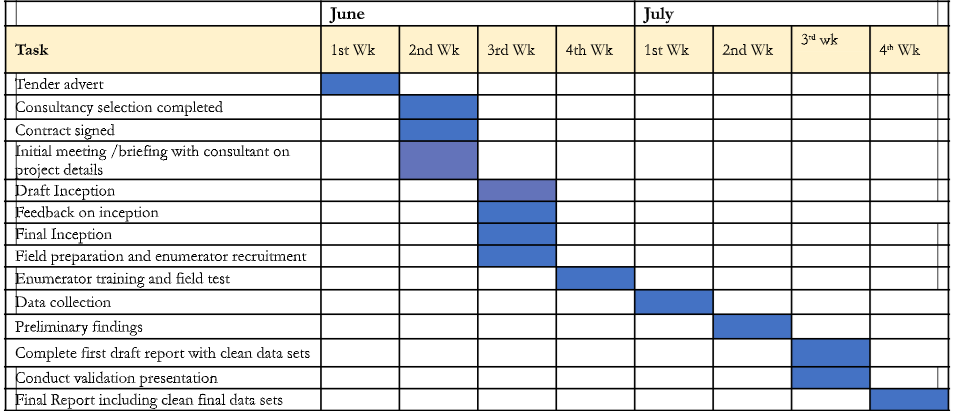
Timelines
Applications
Applications for the consultancy must include the following components, to a total of no more than 15 – 20 pages (excluding appendices, CVs, etc.):
Technical proposal including
- An understanding of the terms of reference.
- The technical approach developed and detailed methodology.
- Details regarding the composition of the team (if applicable), how responsibilities are shared between them, the CVs proposed and the availability of the team members as well as the legal status of the consultancy team and/or evaluation firm to which the consultant(s) belongs.
- The provisional timetable for the evaluation and an estimate of charges per person/per day.
- References from 2 similar previous assignments.
Financial proposal including:
- A detailed itemised budget: The consultant must cover her/his travel and mission expenses and must provide a detailed budget, including all taxes and incorporating a budget break-down (per number of days, unit costs, total costs) fees, living expenses, per diem, travel, etc.).
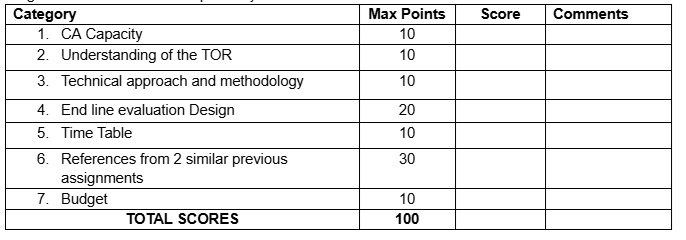
SCORECARD FOR TECHNICAL AND FINANCIAL PROPOSALS
The proposal will be scored on both technical (methodology) and financial (budget) aspects weighted at 70% and 30% respectively
The application must be submitted physically to Executive Director at the UMATI HQ by 10th June 2026 at 5:00PM

Company Information
- Total Jobs 74 Jobs
- Location Tanzania